
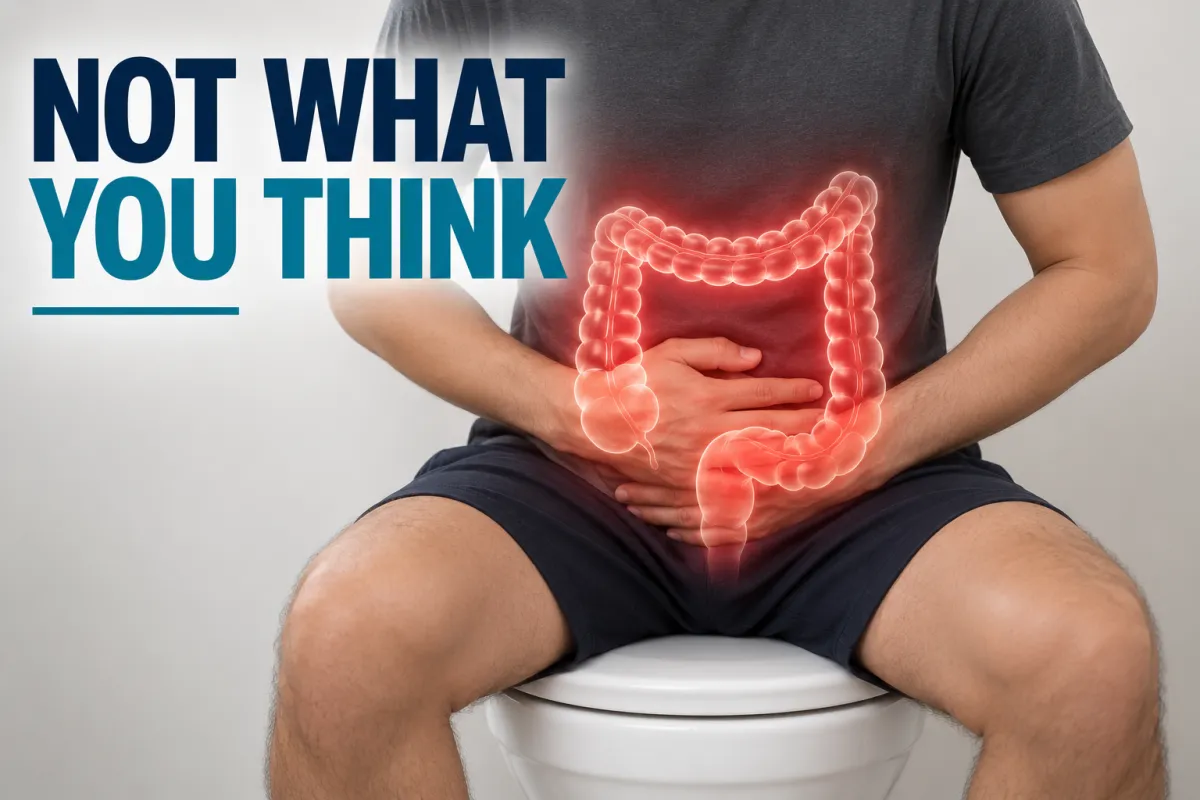
Bloated After Eating? It's Not What You Think
"I'm always bloated after eating, and nobody can explain why." Here's the direct answer most people never get: your gut is one long tube, mouth to back passage, and when the far end is backed up, the near end is where you feel it. That fullness isn't random, it's usually undiagnosed constipation wearing a different name.
Not Every Bloat Is the Same Bloat
Real food intolerances and swallowed air exist, and they cause real bloating too. But before you blame a food, rule out the far more common cause: waste that isn't moving through fast enough, sitting in a tube that runs your entire digestive system, felt at the top even though the actual backup is much further down.
In my experience, it wasn't so much bloating that stayed in my belly, it was gas that wanted to escape, sometimes with an odour that could clear a football stadium. Turns out that's not a coincidence. Smelly gas is basically a hyperlink to constipation, the food's rotting in your gut instead of passing through. That's worth its own article though, not this one.
For years, I called it "feeling bloated" too. It took a decade of misdiagnosis to realize it was the same problem - Constipation. It was just showing up somewhere else.
Dr J. Wesley Jones, MD, FACP, AGAF, who wrote Cure Constipation Now, puts it bluntly: you were designed to poop more like a cow than a cat. Unsurprisingly, his view is that constipation is often the underlying cause behind bloating, and even IBS.
One Long Tube, Not a Separate Problem
This is the part almost nobody explains. Your digestive system isn't a series of separate rooms, it's one continuous tube. If the exit end is moving slowly, pressure and gas back up the whole system, and "bloated" is what that pressure feels like from the inside. What's actually the fastest way to relieve constipation covers the exact mechanism, the Gastrocolic Reflex, that explains why this backup happens in the first place and how to use it on purpose instead of fighting it.
The Quick Way to Tell the Difference
Here's your test: track 2 things for the next 3 days, how often you're actually going, and when the bloating shows up relative to that. If the bloating gets worse the longer it's been since you last went, and eases once you do, that's your exit backing up into your entrance, not a food intolerance. No amount of peppermint tea fixes a tube that's backed up further down. If bloating happens regardless of frequency, especially tied to specific foods, track which ones, that's a genuinely different problem.
Ready to Fix the Actual Cause?
Once you see your gut as 1 tube instead of a set of unrelated symptoms, bloating stops being a mystery, it's just where the backup shows up first. Some medical professionals will tell you anywhere from 3 times a day to once every 3 days is normal, "everyone's different." That's nonsense. I go into more detail in my book, but for now, focus on increasing your frequency of toilet visits and see the impact on your bloating.
If reading suits you, GUTWISE: The Secret to Healing That Pain in the Arse covers the full framework. If video's easier, the GUTWISE Course walks through the same thing.