
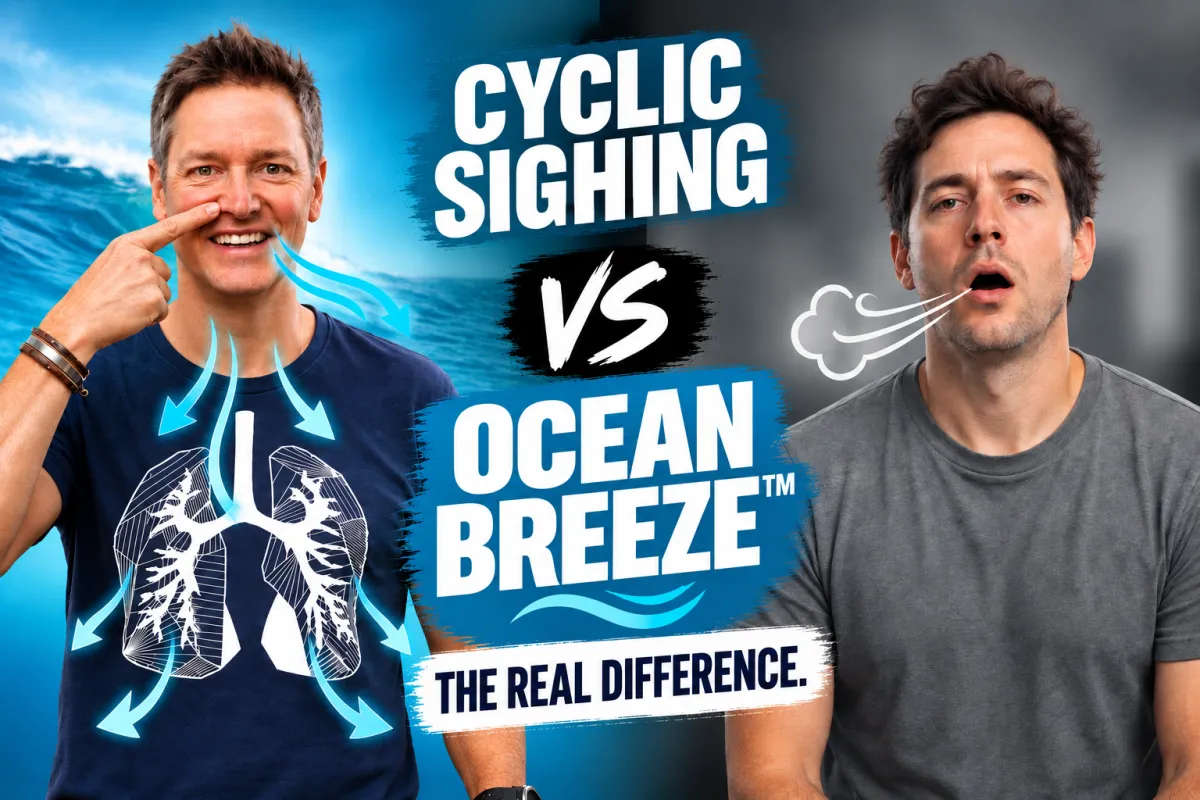
Cyclic Sighing vs Ocean Breeze™: The Real Difference
You've probably never heard of cyclic sighing, but I bet you've done it - maybe just years ago. If you've ever seen an overly tired young child sobbing, you'll notice the involuntary double inhale, sniff, then a slower exhale out their mouth. That natural breathing rhythm is the foundation of the cyclic sighing technique. In 2023, Stanford research found that 5 minutes a day of this breathing practice beats mindfulness meditation at improving mood and calming your nervous system. The new Ocean Breeze™ technique takes that same technique and enhances it into something more powerful, in 4 minutes instead of 5.
Here's exactly how the 2 compare.
I trained under 4x world champion freediver Stig Severinsen, whose entire sport depends on getting breathwork mechanics exactly right. I also looked at the research and studies that explain why freediving techniques work. Ocean Breeze™ is the result of combining the guidance from elite freedivers with the latest neuroscience research on breathwork.
What Is Cyclic Sighing?
Cyclic sighing (sometimes searched for as cyclical sighing) is a structured breathing technique built around a double fuller inhale and a long slow exhale. A double fuller inhale through the nose and an exhale through the mouth. It's a pattern your body can more or less follow naturally when you sigh under stress. The technique simply takes something involuntary and makes it deliberate.
In the 2023 Stanford study led by Dr David Spiegel and Dr Andrew Huberman, 3 breathing conditions were tested against daily mindfulness meditation (cyclic sighing, box breathing, and cyclic hyperventilation with retention) over 1 month, in 108 healthy adults. Cyclic sighing won. 5 minutes a day reduced resting breathing rate and improved mood more than mindfulness did, and more than the other 2 breathing patterns did.
A separate study put a number on why this matters. Researchers gave one group 2 minutes of extended-exhale breathing before a high-pressure business decision task, and gave a control group 2 minutes of rest instead. The breathing group produced nearly 50% more correct decisions, driven by an increase in heart rate variability - the same vagal-nerve mechanism cyclic sighing relies on.
Your exhale is your Willy Wonka golden ticket to calm and recovery.
Why 4 Minutes, Not 5
The Stanford protocol works at 5 minutes a day. Ocean Breeze™ is designed to work in 4. The full case for why shorter works, not just for cyclic sighing but as a general principle, is in Why 4 Minutes of Breathwork Is Enough.
It's not a rounding error. Most studies on breathwork recommend 10 to 15 minutes of practice. But breathing has the power to change your physiology instantly - as little as 2 or 3 breaths can already have a pronounced, positive impact. My clients and I experience that regularly and Dr David Spiegel confirmed it. Breathwork is the ultimate biohack as it is able to instantly change your physiology. A 4-minute practice is also that much easier to build into a habit, tight enough to fit into your day without losing anything the original 5 minutes was doing.
Explore the 14-Day Ocean Breeze™ Challenge →
The OCEAN in OCEAN Breeze™
I coach Ocean Breeze™ through a simple 5-part framework I call OCEAN. An acronym that addresses the 4 common breathing mistakes we all make, and I've written about them in The Four Common Breathing Mistakes:
·Optimal nasal breathing (Mistake 1: mouth vs nose)
·Cadence, the rhythm that stops you over-breathing (Mistake 2)
·Engage your diaphragm, teaching you how to do proper diaphramatic breathing instead of shallow chest breathing (Mistake 3)
·Natural pause, the gap most people rush straight through including in Cyclic Sighing (linked to Mistake 2)
The 5th letter is where Ocean Breeze™ meaningfully diverges from standard cyclic sighing:
·Acoustic exhalation - one of the clear enhancements in Ocean Breeze™, and a technique many say is one of the best ways to stimulate your vagus nerve. Published research shows it also has a profound impact on your physiology: boosting nitric oxide production 15-fold compared with normal breathing, aiding your cardiovascular system and helping your body shift into rest-and-digest mode faster. A fuller picture of how this works is in The Vagus Nerve and Acoustic Exhalation.
The exhalation is one of the enhancements that makes Ocean Breeze™ significantly different from traditional cyclic sighing. It's taught properly, with the timing and delivery that actually make it work, inside the 14-Day Ocean Breeze™ Challenge. Reading about a technique(or even watching it) are not the same as being coached through it . Otherwise we could all be a Messi or Rafael Nadal !
Can I Encourage You ?
I want to encourage you to try this for yourself, not take my word for it.
Most people treat Huberman-style research as the finish line. Ocean Breeze™ treats it as the starting point. Here's the challenge :
right now, as you're reading, do a slow, 4-second inhalation through your nose. Pause. Purse your lips as if blowing out a birthday candle, and let out a long, slow exhalation.
Do 1 more round. How do you feel?
Now imagine 4 minutes built on that, enhanced with input from world-champion freedivers and neuroscience. Well, now you're talking Ocean Breeze™.
The challenge is open. Here's the door.
Start the 14-Day Ocean Breeze™ Challenge →
“Your nose is for breathing. Your mouth is for eating.” - Vaughan Wickins