
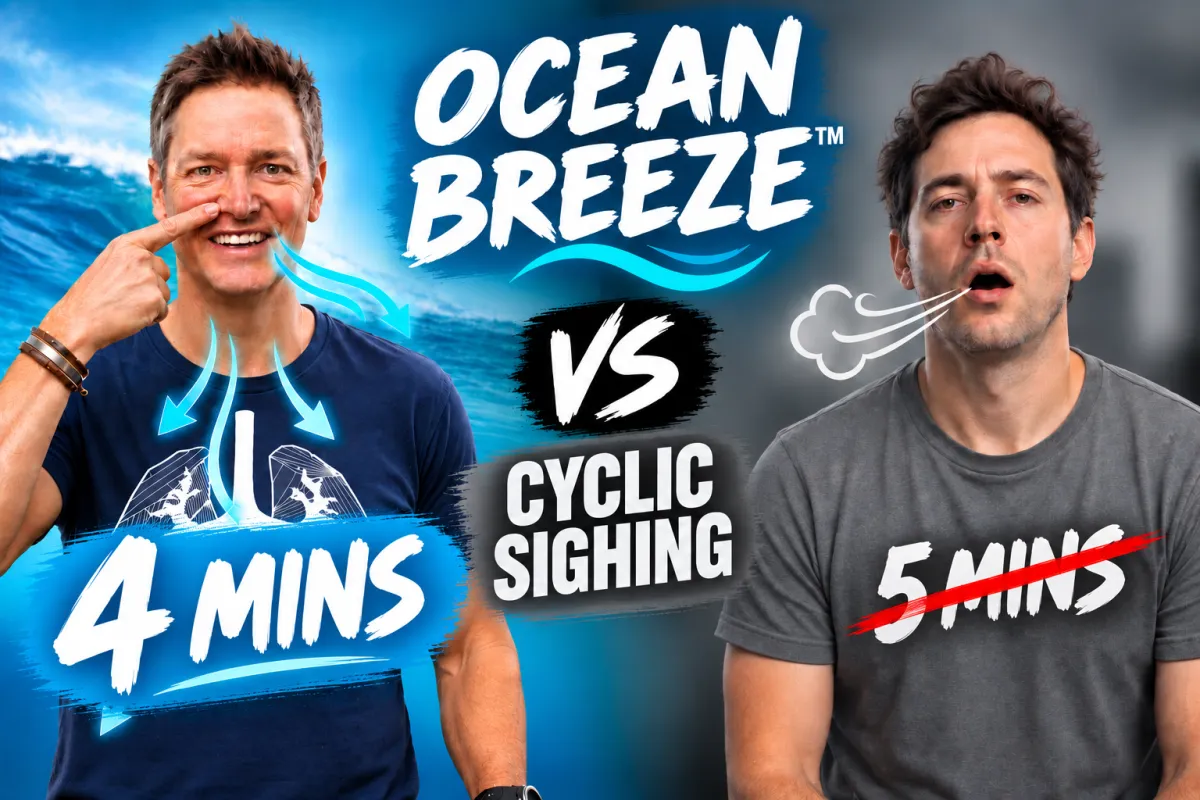
Why 4 Minutes of Ocean Breeze™ Breathwork Is Enough
You may have assumed breathwork needs 15, 20, even 30 minutes to actually do anything.
It doesn't. Your nervous system isn't measuring your effort, it's reading a signal, and a short, precise signal beats a long, sloppy one every time. That's the entire case for 4 minutes and the research behind it is more specific than most people expect.
Trained by World Champion Freedivers, Not a Stopwatch
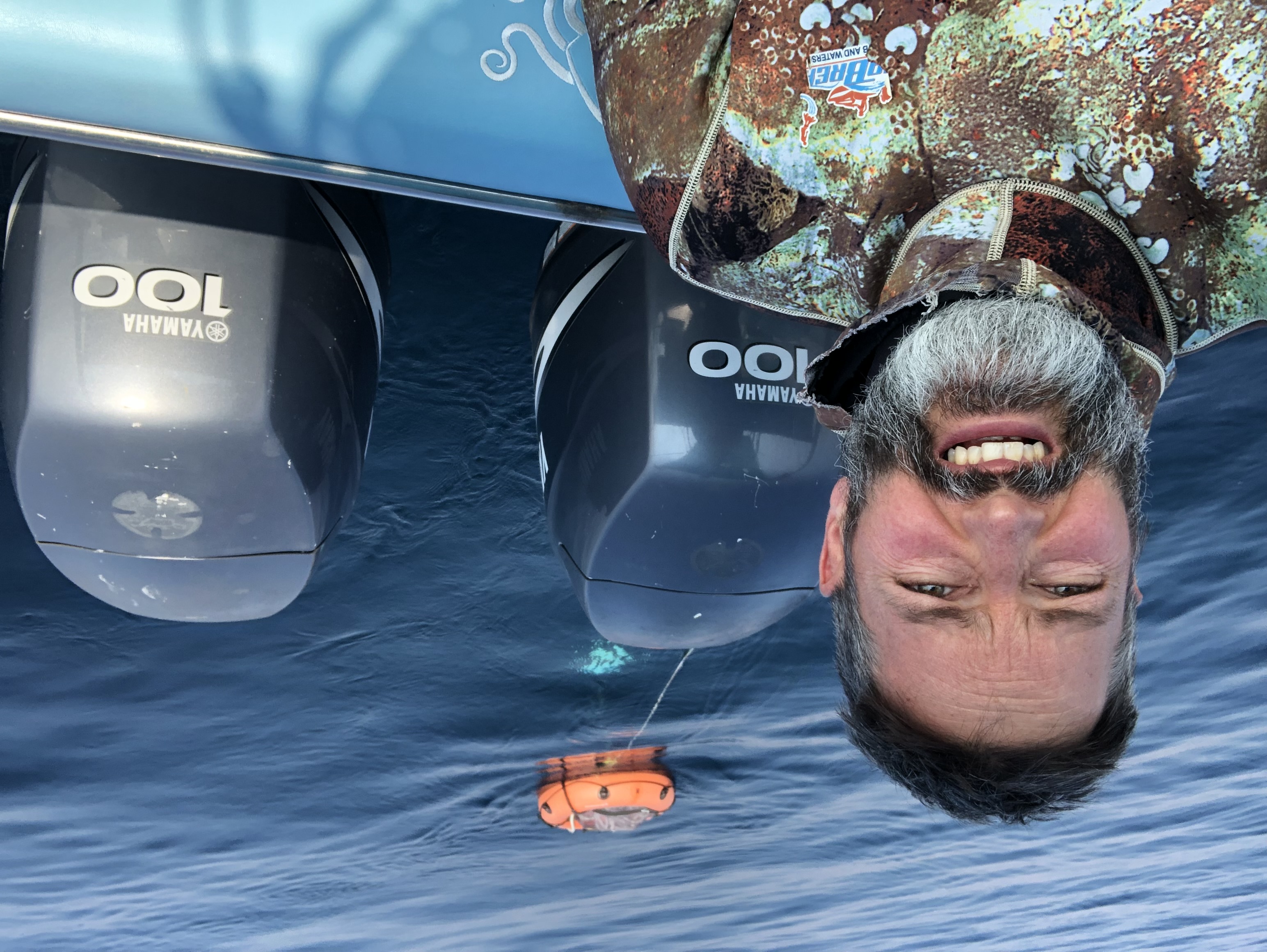
I learned this the hard way, training with a world-champion freediver who treats every breath as discipline, not decoration. Each breath doing exactly what is needed, nothing more. That's the same principle Ocean Breeze™ is built on.
Your Nervous System Isn't a Bank Account
We've been taught that effort equals results. Want to get fit? Hours at the gym. Want to fix your stress? Therapy twice a week, plus a cold water plunge, plus a retreat, plus better sleep, plus an app - you get the point.
Your nervous system doesn't work that way. It isn't a bank account where you deposit minutes and withdraw calm. It's a signal system. You're not trying to accumulate time, you're trying to send one clear message: "You're safe" . That's the message your body needs to stop running the stress programme. Four minutes of the right signal does that. Forty minutes of the wrong one does nothing.
What the Research Actually Shows
Dr David Spiegel, the Stanford psychiatrist who led the cyclic sighing research, found that people start feeling calmer after just 1 or 2 deep breaths - long before the full 5-minute session is done. I see the same thing with clients, using a technique I call Flicker Flame - a back-pocket exercise, just 2 or 3 breaths, under 30 seconds. The published trial backs that bigger picture up at scale: 5 minutes a day, for 1 month, in 108 healthy adults, produced significantly greater improvements in mood and significantly greater reductions in resting breathing rate than mindfulness meditation. Not an hour. Five minutes.
The effect isn't limited to calm, quiet conditions either. In a study of 62 military cadets, both box breathing and cyclic sighing produced significantly greater increases in heart rate variability in the minutes immediately after maximal physical exertion, compared with spontaneous, uncontrolled breathing. These weren't people sitting in a quiet room. They'd just finished pushing themselves as hard as they could, and 5 minutes of structured breathing moved the needle.
And this isn't 1 lucky study. A 2022 meta-analysis pooling 223 studies confirmed that voluntary slow breathing robustly increases vagally-mediated heart rate variability at 3 stages: during the practice itself, immediately after, and following multi-session use over weeks. The benefit shows up immediately during the practice and it accumulates.
The One Tooth Principle
Stanford behaviour scientist BJ Fogg spent years studying why habits fail. Awareness precedes change, as he puts it. The fastest way to build that awareness is starting so small you can't talk yourself out of it. His example: floss 1 tooth. Not all of them, 1. Because the goal on day 1 isn't clean teeth, it's showing up.
4 minutes of breathing strikes an even balance. After just 2 or 3 Ocean Breeze™ breaths, you've already had a positive impact on your physiology / at 4 minutes, well you're set to start accumulating benefits. Plus, 4 mins is easier to commit to than 5. Any longer and you're likely to do it twice and by day 5 it's quietly gone the way of the treadmill in your spare room.
Explore the 14-Day Ocean Breeze™ Challenge →
Why Ocean Breeze™ Is Built for 4, Not 40 minutes
If 5 minutes of standard cyclic sighing already beats mindfulness, why does Ocean Breeze™ run at 4? Because compressing the signal doesn't just save you a minute, it forces every part of the practice to earn its place. No padding, no filler. The full technique, including how the various enhancements all fit into 4 minutes without losing what the original 5 was doing, is covered in Cyclic Sighing vs Ocean Breeze™: What's the Difference?.
It's deliberate design, not just a shortcut. A well executed 4-minute session beats a sloppy 40-minute session every time. The same way a good form 20-minute weights session beats an hour of half-effort reps. That good form includes how to do proper diaphramatic breathing. Part of why so little time is needed also comes down to stimulating a nerve doing the work, covered in The Vagus Nerve and Acoustic Exhalation.
“But I Like Doing Longer Sessions”
By all means do them. 4 minutes is the minimum effective dose, not the maximum allowed. Build the habit at 4 minutes first. Extend later if you'd like to, once it's automatic rather than optional.
Is There a Reason Not to Do This?
You already breathe 20,000 times a day. Each breath, either a micro dose of stress or a micro dose of calm. You may as well do it right. But don't take my word for it. Right now, as you're reading. Do a slow, 4-second inhalation through your nose. Pause. Purse your lips as if blowing out a birthday candle, and let out a long, slow exhalation. Do 1 more round. How do you feel?
Now imagine 4 minutes built on that, enhanced with input from world-champion freedivers and neuroscience. Well, now you're talking Ocean Breeze™.
The challenge is open. Here's the door.
Start the 14-Day Ocean Breeze™ Challenge →
“Your nose is for breathing. Your mouth is for eating.” - Vaughan Wickins