
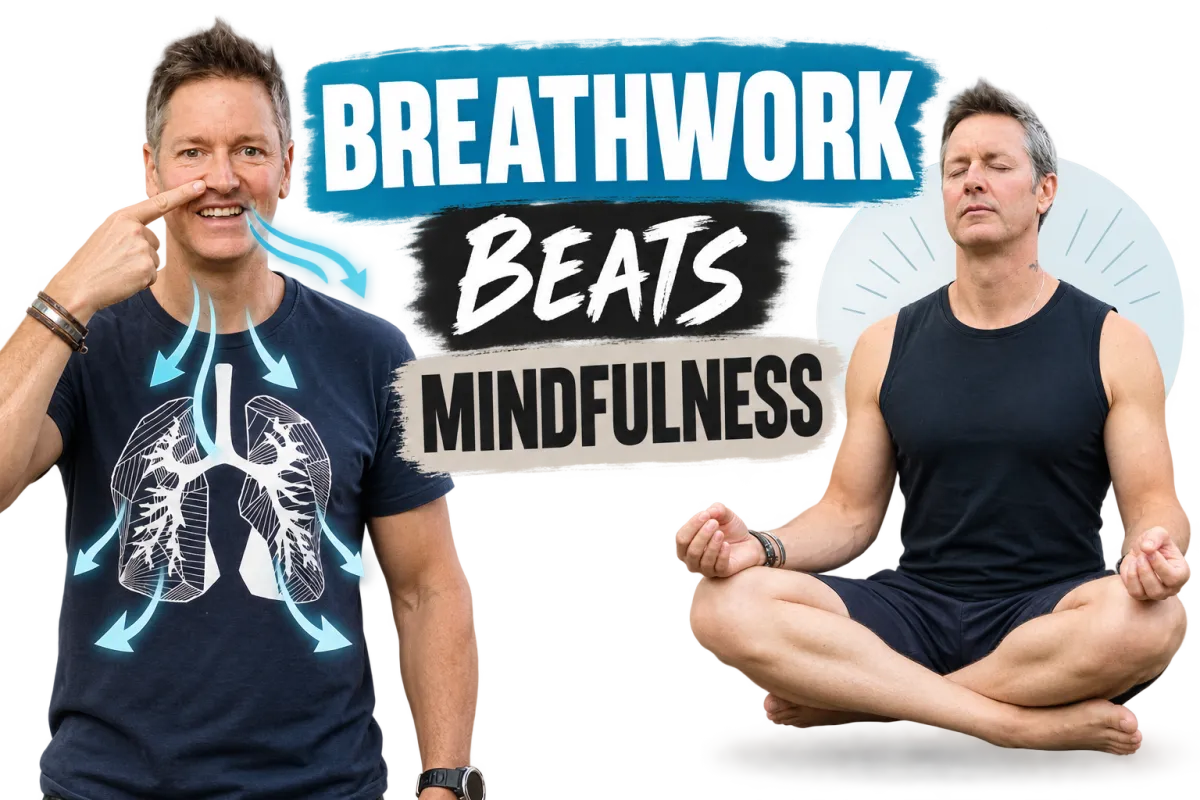
Ocean Breeze™: The Breathing Method That Beats Mindfulness
Mindfulness has become a household word. We're swamped with free "mindfulness" apps, all promising the same thing: calm, if you can just sit still for long enough.
But what if there's a faster way? A simple daily practice that's more effective, quicker to deliver results, grounded in peer-reviewed science - and doesn't need an app, a subscription, or a silent retreat.
Your phone comes with a manual. Your car comes with a manual. Your body? Nothing. Just "good luck, try not to panic."
Recent research has revealed something most people haven't yet heard : breathwork outperforms mindfulness meditation. Breathwork outperforms in mood improvement and reducing stress, and the effects can be felt in seconds.
The Science Is Catching Up
In 2023, a research team at Stanford University, led by Dr David Spiegel and Dr Andrew Huberman, ran a month-long study comparing 3 different daily breathing exercises against traditional mindfulness meditation.
The result: cyclic sighing, a breathing technique built around a long, slow exhale, produced significantly greater improvements in mood and significantly greater reductions in resting breathing rate than mindfulness meditation did, in just 5 minutes a day.
This isn't a lone finding either. A 2022 meta-analysis pooling 223 studies confirmed that voluntary slow breathing reliably increases the vagal activity linked to calm, both during practice and in the weeks that follow. So, intentionally changing the rhythm and depth of your breath can deliver faster emotional benefits than simply observing your thoughts, and it isn't just one study saying so.
Why Structured Breathing Works Faster Than Mindfulness
Mindfulness relies on mental discipline, noticing thoughts, letting them pass, staying present. It's a skill, and skills take a lot of practice to pay off.
Breathing works differently. Your breath is one of the only systems in your body that runs automatically and that you can consciously override. Change the pattern of your breath, and you send a direct, real-time signal to your nervous system: specifically, via your vagus nerve, the main communication line between your brain and body that governs whether you're in "fight-or-flight" or "rest-and-digest" mode. This is the same mechanism researchers point to when explaining why slow breathing works at all, it strengthens your baroreflex, your body's own blood-pressure-and-heart-rate control loop.
Mindfulness asks your mind to calm your body. Structured breathing asks your body to calm your mind. That's the shortcut, and it's why the effects show up in minutes rather than weeks.
From Elite Freediving to Everyday Resilience
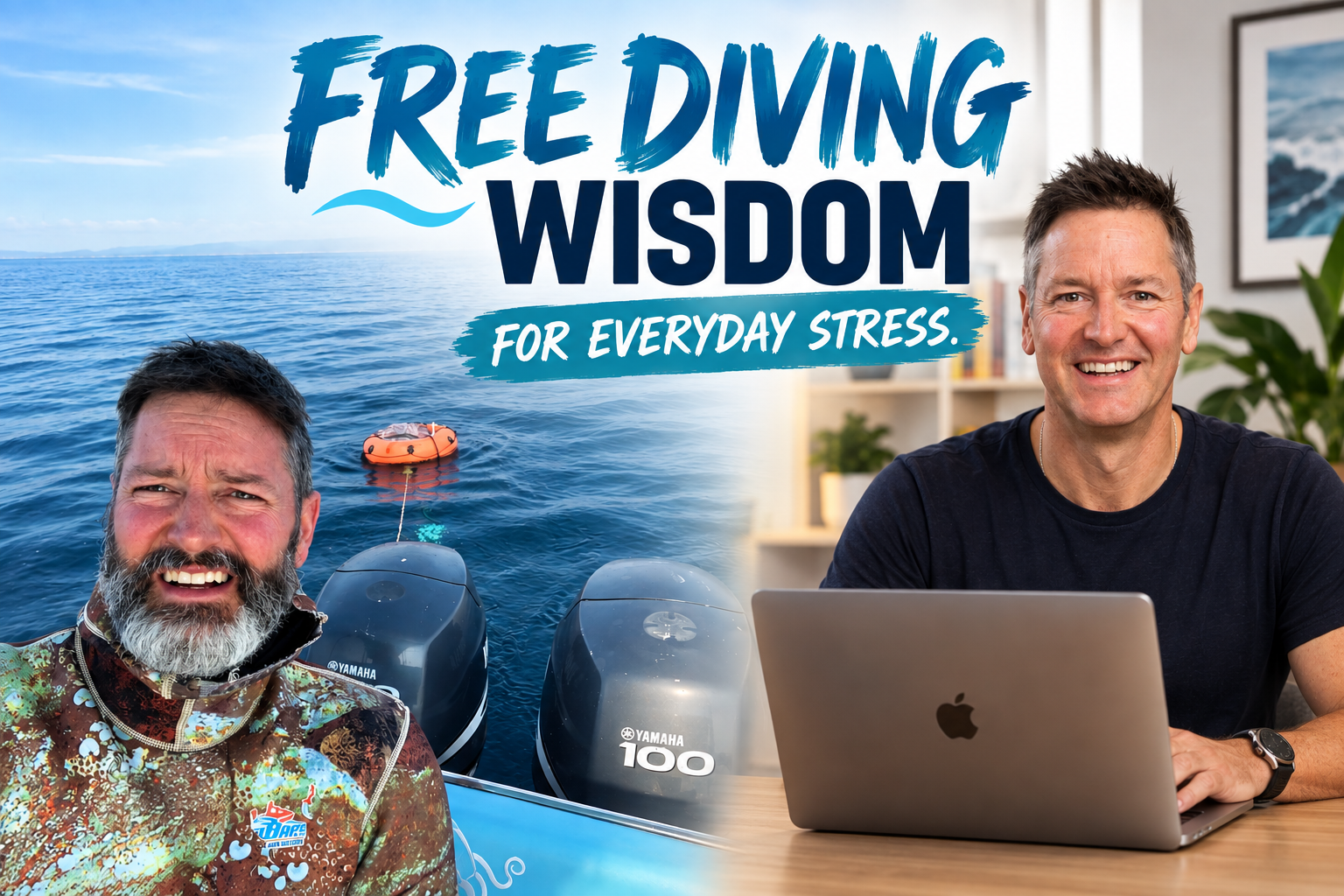
I didn't learn this from a wellness app. I trained directly with elite freedivers and performance breathing coaches, learning how your breath is used to unlock everything from athletic performance, to sharper focus, and control fear, anxiety and panic.
Freedivers don't get to be wrong about their breathing. What I learned in their world has become the foundation for something anyone can use, not to hold your breath underwater, but to remain calm in overwhelming situations. To handle stress, anxiety, poor sleep, and a foggy, unfocused mind.
That's what's become my signature Ocean Breeze™ Method.
What Is the Ocean Breeze™ Method?
The Stanford protocol was a great starting point. But after training with world-champion freedivers and studying the supporting research, I found huge room for enhancement, enough to make the practice super effective in just 4 minutes a day.
The Ocean Breeze™ Method builds on cyclic sighing by adding several extra elements designed to send a stronger, clearer signal to your nervous system in less time. One of those elements has been shown in published research to increase a key cardiovascular-supporting molecule, Nitric Oxide, 15-fold compared with normal breathing, helping the body relax blood vessels, improve oxygen uptake, and shift more quickly toward “rest and digest." Ocean Breeze™ also trains you how to do proper diaphramatic breathing.
I go into exactly how and why each element is in the protocol, in Cyclic Sighing vs Ocean Breeze™: What's the Difference?, Why 4 Minutes of Ocean Breeze™ Breathwork Is Enough, and The Vagus Nerve and Acoustic Exhalation. The full step-by-step technique itself is taught inside the 14-Day Ocean Breeze™ Challenge.
Take a Breath, Transform Your Day
You don't need an app or a silent retreat. Just your breath, 4 minutes, and a willingness to test it for yourself. Here's the challenge - right now, as you're reading. Do a slow, 4-second inhalation through your nose. Pause. Purse your lips as if blowing out a birthday candle, and let out a long, slow exhalation. Do 1 more round. How do you feel?
Now imagine 4 minutes built on that, enhanced with input from world-champion freedivers and neuroscience. Well, now you're talking Ocean Breeze™.
The challenge is open. Here's the door.
Sign up for the 14-Day Ocean Breeze™ Challenge →
“Your nose is for breathing. Your mouth is for eating.” - Vaughan Wickins